Insights · Strategy & Work
AI Is Becoming the Software
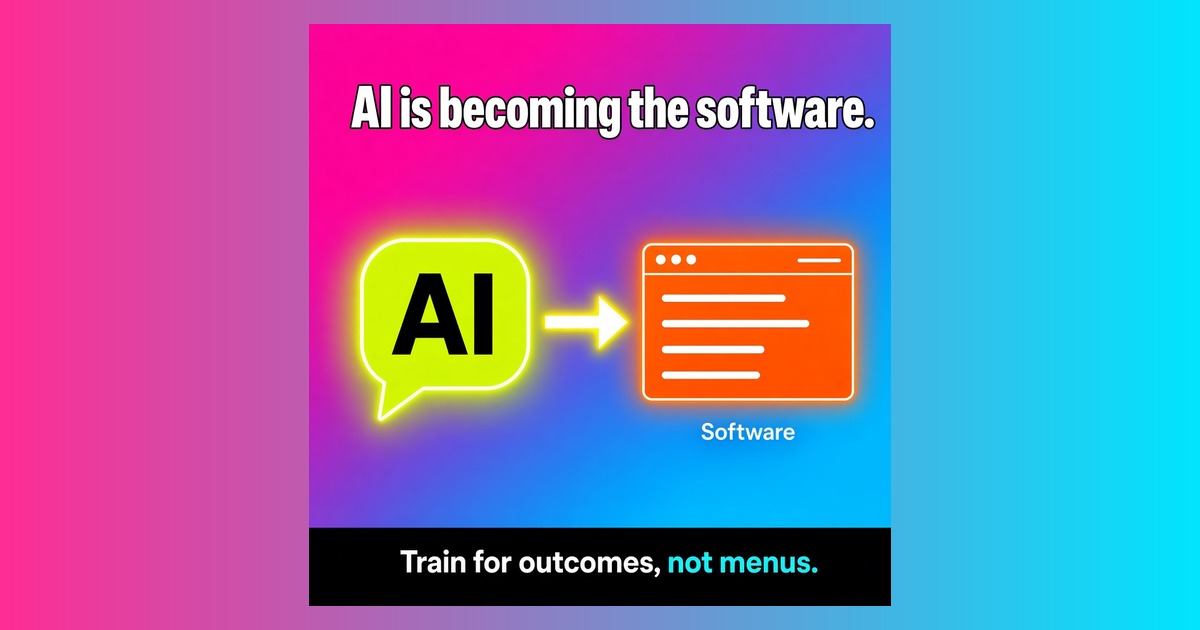
For a decade, the default answer to every new job was another application. Write here. Design there. Analyze somewhere else. Export. Paste. Repeat. Seat licenses sold us menus. People became the glue between five dashboards.
That pattern is shifting. Generative and agentic AI are not just a button inside the old stack. Increasingly, the AI is the software people experience — and the familiar screens run quietly underneath, called as services rather than lived in as destinations.
The old stack
The software era we grew up with optimized for feature lists and seats. Value lived in the interface you learned and the suite your organization licensed. Training meant walking people through ribbons, tabs, and click paths. Procurement meant comparing checklists. Success meant log-ons and adoption curves.
None of that was wrong for its time. It built systems of record and shared workflows. But it also left humans as the integration layer: copy from the ticket system, paste into the spreadsheet, summarize in the deck, chase the approval in email. The work stayed fragmented even when the tools were “best of breed.”
What’s changing
Copilots and agents are moving from sidekick to front door. You state the outcome; the system plans steps, pulls context, and acts across tools. The app becomes a backend — data, rules, and capabilities — while the conversation (or the agent) becomes the interface.
You can already see it in practice:
- Coding agents draft, test, and open pull requests instead of treating the IDE as the only place work happens.
- Support agents triage tickets, draft replies, and escalate with context — so the human handles judgment, not swivel-chair lookups.
- Workspace agents turn meeting notes into plans, tasks, and follow-ups without another round of manual formatting.
- Design and content ops move through one generative flow — draft, edit, localize, publish — rather than a chain of export-and-import steps. Platforms like Canva Magic Studio illustrate that pattern for many teams.
- Analysis via chat answers “what changed last quarter?” without requiring everyone to live inside the spreadsheet first.
Products are mentioned as examples only. We have no affiliation with any vendor named.
Industry research is catching up to the pattern. Gartner predicts that by the end of 2026, about 40% of enterprise applications will include task-specific AI agents — up from under 5% in 2025. IDC’s work on the agentic evolution of enterprise apps finds many leaders already treat agents as the new enterprise applications. Bain’s technology reporting frames agentic AI as something that can enhance, compress, or replace SaaS workflows — with pricing under pressure to follow outcomes, not seats. Product leaders at major platforms have argued the same shift in plainer language: agents become the UI; apps take a back seat.
In a widely discussed conversation (the BG2 interview with Microsoft CEO Satya Nadella), the framing is blunt enough that operators should pay attention: when leaders ask why they still need the old screen for a job agents can orchestrate, categories start to blur. That is a hypothesis about direction, not a claim that every desktop tool vanishes tomorrow.
What collapses
Categories blur first. Teams stop shopping only for “the app for X” and start directing a workflow that pulls capabilities behind the scenes. The human-as-glue role — bouncing between five systems to finish one task — is the first thing under pressure.
Training that only teaches menus ages fast. So does a readiness plan that says “add AI to every existing screen” without redesigning the work. If your measure of success is still “people logged into Tool A,” you may miss that the outcome already shipped through an agent that barely opened Tool A’s UI.
What still matters
Software is not disappearing overnight. Systems of record, identity, permissions, audit trails, and proprietary data still matter — often more, because agents amplify whatever they can reach. Governance is not optional when a workflow can act across systems without a person clicking every step.
Judgment stays human. The AI can run the steps. A person still owns the decision: what to trust, what to escalate, what not to automate, and how to explain the result. Readiness that ignores that line produces confident mistakes at scale.
For schools and universities, the same principle shows up in classroom practice: students (and staff) need to know when AI is off-limits, when it may support the work, and when it may sit beside them as a co-pilot — and they need to substantiate, edit, and explain. Tools change; ownership of thinking does not.
What leaders and educators should do this month
Skip the five-year slide deck. Try a short, concrete pass:
- Map one painful workflow end to end — the five tools people actually bounce between. Name the handoffs a human still glues together.
- Pilot one agentic or copilot path on that workflow with clear rules: what data it may touch, what it may send, and when a person must approve.
- Retrain for direction, not menus. Teach people to specify outcomes, constrain context, review outputs, and document what changed after the model replied.
- Change one success metric from seats or log-ons to work completed with quality checks (tickets resolved, drafts shipped, analyses verified).
- Write the human line in plain language for your context — classroom, office, or shop floor. If an assignment or process is unmarked, default to caution, not guesswork.
The readiness question
Seat licenses sold menus. Agents sell outcomes. The organizations that adapt will keep their data, rules, and judgment sharp — and stop asking people to be the integration layer between yesterday’s screens.
So ask your team one practical question this week: are you training people to click through tools, or to direct the work?
If you want a structured starting point, take the free AI readiness self-assessment, or get in touch for a short intro call. No pitch deck required — just clarity on where you stand and what to practice next.
Sources
- Gartner — 40% of enterprise apps with task-specific AI agents by end of 2026
- IDC — The Agentic Evolution of Enterprise Applications
- Bain & Company — Will Agentic AI Disrupt SaaS? (Technology Report 2025)
- Salesforce — AI Agents Will Become the New UI
- BG2 interview — Satya Nadella on agents and the software layer (YouTube)
Related: AI Traffic Light · Factory Shift · Main site Insights
A free intro call.
No pitch deck.
We’ll talk through whether your readiness plan is still training menus — or directing outcomes.